Workplace scenarios covering communication, teamwork, decision-making and professional judgement, in the formats employers actually set. Every scenario below comes with the scored key explained.
A situational judgement test measures how well you handle realistic situations at work. Employers use it to sift graduate applicants before interview. You are given a short scenario and several possible responses, and you judge how effective each one would be. There are no calculations; the test is about the decisions you would make and the reasons behind them.
A situational judgement test, or SJT, is a psychometric test that presents
hypothetical workplace scenarios and asks how you would respond. Unlike
aptitude tests that measure a concrete skill such as numeracy or verbal
reasoning, an SJT assesses judgement and behaviour: how you handle a
difficult colleague, a demanding client, a missed deadline or an ethical
dilemma.
There is rarely one perfect answer. Your responses are compared against the
behaviours the employer values for that role, usually drawn from an internal
competency framework, which is why understanding the employer and how the job
works in practice matters as much as the scenario itself.
An SJT does two things at once. It shows the employer how your judgement is
likely to hold up in the situations the role involves, and it gives you a
preview of the kinds of decision you would face if you took the job.
How are situational judgement tests scored?
Most employers score you against other candidates, not against a fixed
pass mark: your raw score becomes a percentile. Competitive graduate
schemes commonly sift at around the 70th to 80th percentile. Attempting
questions matters, because most tests are built so few candidates finish,
and guessing usually pays: negative marking is rare, but check the
instructions.
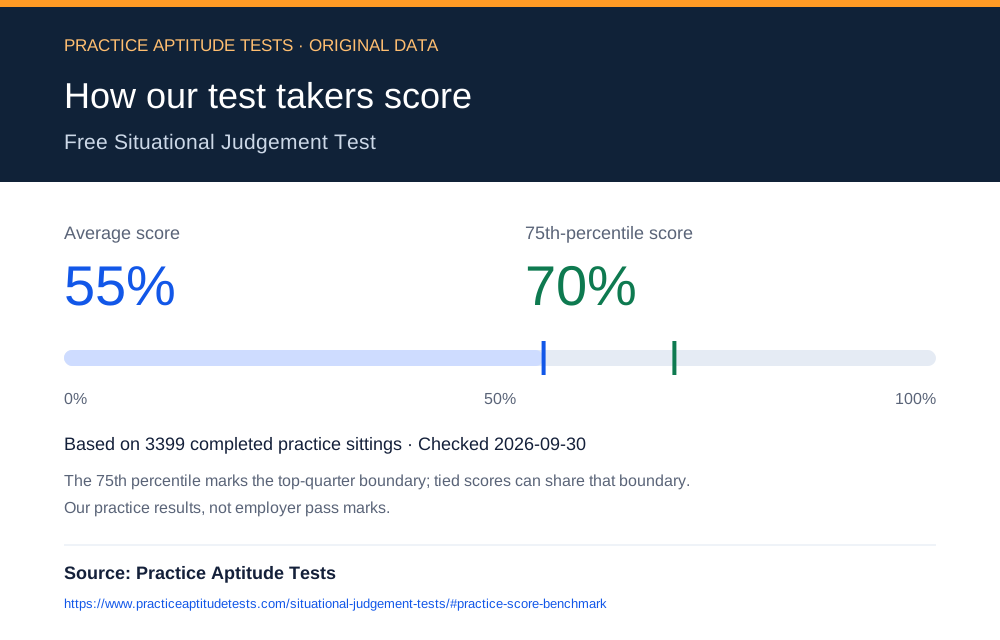
Based on 3399 completed practice sittings, all time. Checked 30 September 2026.
The 75th percentile marks the boundary of the top quarter of recorded scores; tied scores can share that boundary. These are our practice results, not employer pass marks.
How we calculate these figures
We use all-time completed, scored attempts at this practice test. Repeat attempts count separately, so the sample is sittings rather than unique people.
The average is the mean score across those sittings. The 75th percentile comes from their recorded score distribution. The “checked” date is when we retrieved the figures, not the period when the tests were taken.
Sharing these figures? Please credit Practice Aptitude Tests and link to this page.
Who uses situational judgement tests?
Situational judgement tests are used wherever an employer needs to compare
large numbers of candidates fairly, especially when grades, CVs and
interviews do not separate them well. They are most common in graduate
schemes and internships, professional services, banking, finance and law,
the Civil Service Fast Stream, and healthcare training pathways.
Most employers license their tests from a small number of publishers,
and the timing and question style vary between them, so find out which
publisher your employer uses before you prepare seriously. It is usually
named in the invitation email. Our test publisher guides
cover each format, and the employer guides
cover specific companies’ processes.
Rated 4.8 out of 5 across 1,791 reviews. A selection:
Insightful Reflection on the Situational Judgment Test Experience
The test was well-structured, and the scenarios felt realistic and relevant to the role. Some situations required careful thought, but overall, the questions were clear. Managing time was a bit challenging, but it helped me think quickly and prioritize decisions.
Prince Osei · Ghana · February 2025
Challenging and Insightful Test
This test provided a well-rounded evaluation of analytical and decision-making skills. The numerical reasoning questions were challenging but well-structured, and the situational judgment scenarios felt realistic and relevant to workplace challenges. It helped me identify areas where I need to work on. Great test!
Rasheda Begum · Bangladesh · December 2024
A good way to make yourself familiar before taking the actual test
they give you a timed option and the practice option for the test. They also let you know which of the answers are correct/incorrect when you're taking a practice test
Sitara Amaralia · Indonesia · August 2023
Start practising today
Take a free test in any format, then upgrade when you know which one you need.