Shape sequences, matrices, pattern completion and odd-one-out, in the formats employers actually set. Every question below comes with the rule explained, not just the answer.
An abstract reasoning test measures how well you identify patterns and relationships between shapes, with no words or numbers involved. Employers use it as a culture-fair measure of reasoning before interview. You are shown a sequence or set of figures and asked to work out the underlying rule, then pick the shape that comes next or completes the pattern. It rewards spotting the rule quickly and applying it accurately.
An abstract reasoning test measures how well you spot the rule that connects
a set of shapes, and how fast you can do it. It is a test of fluid
intelligence: the ability to reason with unfamiliar information rather than
recall anything you have learned. There is no maths, no vocabulary and no
subject knowledge involved, which is exactly why employers rely on it.
The skill transfers to real work. Someone who can look at unfamiliar data,
see the underlying pattern and act on it quickly is doing the same thing a
developer does with a new codebase or an analyst does with a dataset they
have never seen. Because the questions carry no cultural or educational
baggage, two candidates with very different backgrounds can be compared on
the same footing.
In practice you are shown shapes that change according to a hidden rule, and
you choose the option that fits. Almost every question is multiple choice
with four or five options, and you usually have a minute or less for each
one.
How are abstract reasoning tests scored?
Most employers score you against other candidates, not against a fixed
pass mark: your raw score becomes a percentile. Competitive graduate
schemes commonly sift at around the 70th to 80th percentile. Attempting
questions matters, because most tests are built so few candidates finish,
and guessing usually pays: negative marking is rare, but check the
instructions.
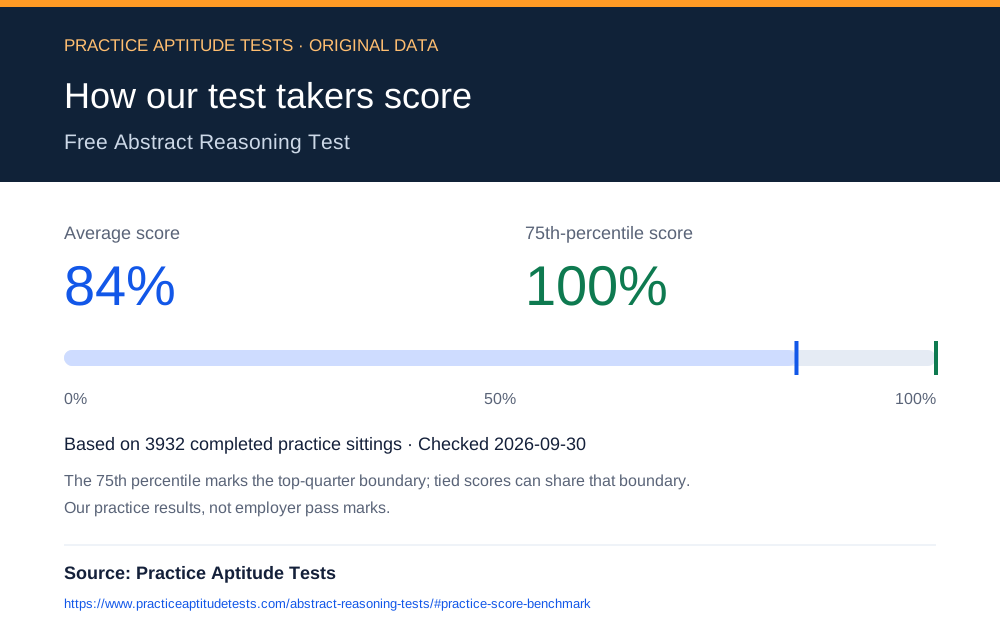
Based on 3932 completed practice sittings, all time. Checked 30 September 2026.
The 75th percentile marks the boundary of the top quarter of recorded scores; tied scores can share that boundary. These are our practice results, not employer pass marks.
How we calculate these figures
We use all-time completed, scored attempts at this practice test. Repeat attempts count separately, so the sample is sittings rather than unique people.
The average is the mean score across those sittings. The 75th percentile comes from their recorded score distribution. The “checked” date is when we retrieved the figures, not the period when the tests were taken.
Sharing these figures? Please credit Practice Aptitude Tests and link to this page.
Who uses abstract reasoning tests?
Abstract reasoning tests are standard in graduate recruitment across
technology, engineering, consulting, finance and other data-driven sectors.
If a role rewards spotting patterns and learning quickly, expect one.
Software developers, engineers, analysts, consultants, project managers and
graduate scheme applicants are the most commonly assessed.
Most employers license their tests from a small number of publishers,
and the timing and question style vary between them, so find out which
publisher your employer uses before you prepare seriously. It is usually
named in the invitation email. Our test publisher guides
cover each format, and the employer guides
cover specific companies’ processes.
Video tutorials
The methods behind the questions above, from our team
Rated 4.9 out of 5 across 434 reviews. A selection:
Overall review
It was fine but I fell like you should definitely add more questions as it would be more fun, challenging and the results would be more accurate. You did the questions from easy to hard, so that was one good thing about as everyone needs a challenge eventually. Pretty good 👍😊👍
Tiffany · Malaysia · May 2023
Good Practice
The practice abstract reasoning test I just took was a breeze. The questions were straightforward and didn't require much critical thinking. Overall, it was a good warm-up for more challenging tests to come. It was a great way to sharpen my skills and brush up on my problem-solving
Daniel Stewart · Australia · January 2023
Great practice app
I like that it has a practice and timed test because you will be more prepared and it has a solution for every practice test
dans · Philippines · September 2022
Start practising today
Take a free test in any format, then upgrade when you know which one you need.