
Good exercise to get in the right frame of mind.
I enjoyed the simplicity, structure and ease of being able to participate and complete the test. The questions got me thinking and demonstrated to me that I have to clean the cobwebs from my brain.
Addition, subtraction, multiplication, division, fractions, decimals, percentages, rounding and averages, at the pace employers actually test. Every question below comes with the working shown.
Free · No sign-up · Scored the moment you finish
A basic numeracy test measures how confidently you handle everyday arithmetic without a calculator. Employers use it to check the core maths a role relies on before interview. You work through addition, subtraction, multiplication, division, percentages and simple fractions, then choose the correct answer from the options given. Accuracy under a little time pressure is what it rewards.
Start the free test. It opens full screen, without leaving this page.
| Score | What it suggests |
|---|---|
| 9 to 10 | Comfortably above the bar for most graduate schemes |
| 7 to 8 | Around the typical pass mark. Worth practising for speed |
| 5 to 6 | Below most employer thresholds. Focus on method before speed |
| 4 or fewer | Work through the worked solutions above before retrying |
Employers set their own thresholds and many sift on the top percentage of applicants rather than a fixed mark, so treat these as a guide.
One test tells you the style. A pack gives you the pace: batches under time pressure, marked, with the working shown.
A basic numeracy test measures whether you can do everyday maths quickly and accurately, without a calculator in most cases. It is a foundation-level assessment aimed at the arithmetic almost every job touches: handling money, checking figures, working out totals and reading simple data.
The maths sits at secondary school level, around age sixteen. You will be asked to add, subtract, multiply and divide, to work with fractions, decimals and percentages, to round numbers sensibly and to find averages. Questions are almost always multiple choice.
What makes it a test rather than a worksheet is the clock. You typically get between 45 seconds and two minutes per question, so being well practised and efficient matters as much as knowing the method.
Basic numeracy tests cover the core arithmetic taught by age sixteen, applied to short, practical questions. The topics are predictable, which is exactly why practice pays off.
Expect questions on:
Some publishers also present short tables or charts and ask you to read a figure and calculate from it, which is where basic numeracy starts to look like numerical reasoning.
The mean, median and mode are three different kinds of average, and mixing them up is one of the most common mistakes in the whole test. Each has a one-line definition worth committing to memory.
When a question names one of the three, underline it. The answer options are usually built so that the mean, median and mode all appear, and picking the wrong average is the trap.
Often not, and that is the single biggest thing to check before you sit one. Many basic numeracy tests are designed to assess mental arithmetic, so a calculator is not allowed and the numbers are kept manageable by hand.
Where a calculator is permitted, an on-screen or basic model is usual. If you are sitting the test at an assessment centre you may be given one, but it is worth taking your own where the rules allow, because you will be faster on buttons you know.
Either way, estimating first saves time. If you can see an answer is roughly a quarter, or clearly more than half, you can often eliminate two or three options before doing the exact sum. Check the instructions in your invitation, because the calculator rule changes the right approach.
Most employers score you against other candidates, not against a fixed pass mark: your raw score becomes a percentile. Competitive graduate schemes commonly sift at around the 70th to 80th percentile. Attempting questions matters, because most tests are built so few candidates finish, and guessing usually pays: negative marking is rare, but check the instructions.
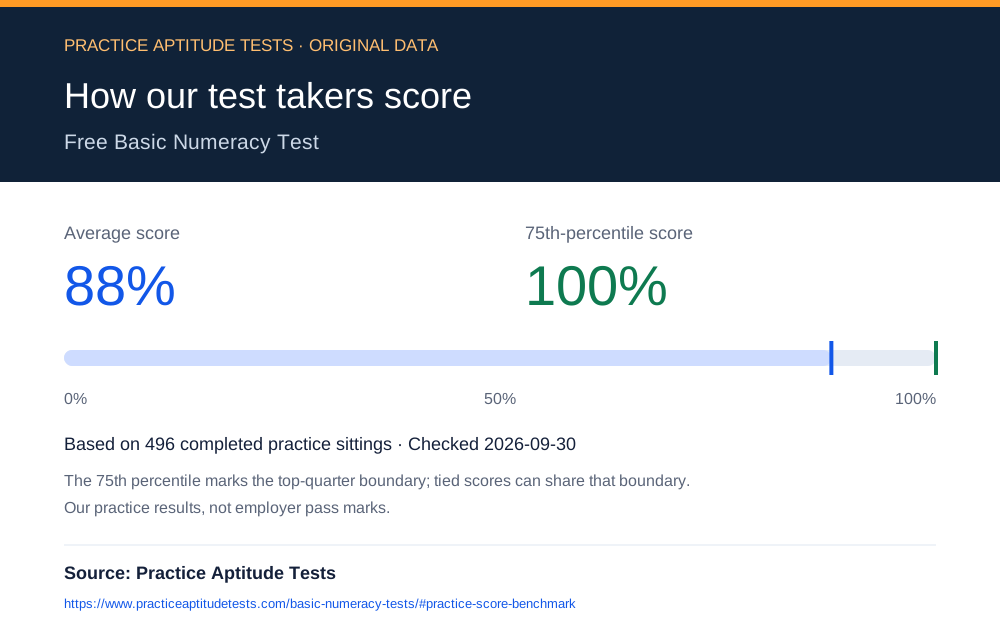
Results from our basic numeracy test.
Source: Practice Aptitude Tests
Based on 496 completed practice sittings, all time. Checked 30 September 2026.
The 75th percentile marks the boundary of the top quarter of recorded scores; tied scores can share that boundary. These are our practice results, not employer pass marks.
We use all-time completed, scored attempts at this practice test. Repeat attempts count separately, so the sample is sittings rather than unique people.
The average is the mean score across those sittings. The 75th percentile comes from their recorded score distribution. The “checked” date is when we retrieved the figures, not the period when the tests were taken.
Sharing these figures? Please credit Practice Aptitude Tests and link to this page.
Basic numeracy tests are used wherever a role involves handling figures, which covers a huge range of operational, customer service, administration, help desk and commercial jobs. If the work touches money, stock or data, expect one.
Most employers license their tests from a small number of publishers, and the timing and question style vary between them, so find out which publisher your employer uses before you prepare seriously. It is usually named in the invitation email. Our test publisher guides cover each format, and the employer guides cover specific companies’ processes.
Work out your budget before you start and stick to it, because getting stuck on one question is what sinks most candidates. Divide the time by the number of questions and you have a rough seconds-per-question figure to pace against.
Three habits help:
The methods behind the questions above, from our team
Rated 4.9 out of 5 across 132 reviews. A selection:
I enjoyed the simplicity, structure and ease of being able to participate and complete the test. The questions got me thinking and demonstrated to me that I have to clean the cobwebs from my brain.
I liked everything about the test: the questions were very clear and easy to answer, it's just that you have to be careful when reading and understand clearly what is asked.
I like the layout, very easy to read and understand. The way the answers were shown were simple to follow and efficient and informative. Great practice test.
Take a free test in any format, then upgrade when you know which one you need.