


Understanding and thinking
I liked how there was enought time for 10 questions and that the type of questions were varied. I was also impressed by how I could think of one possible correct answer.
Shape sequences, matrices, A/B sets and odd-one-out, in the formats employers actually set. Every question below comes with the rule explained, not just the answer.
Free · No sign-up · Scored the moment you finish
An inductive reasoning test measures how well you spot patterns in unfamiliar information and predict what comes next. Employers use it to gauge problem-solving with new material before interview. You are shown a series of shapes or figures and asked to infer the rule that links them, then choose the option that fits. It rewards flexible thinking and quick pattern recognition rather than learned knowledge.
Start the free test. It opens full screen, without leaving this page.
Prefer paper?
Download this test as a PDF or a second practice paper with different questions.
Worked solutions included. No sign-up.
| Score | What it suggests |
|---|---|
| 9 to 10 | Comfortably above the bar for most graduate schemes |
| 7 to 8 | Around the typical pass mark. Worth practising for speed |
| 5 to 6 | Below most employer thresholds. Focus on method before speed |
| 4 or fewer | Work through the worked solutions above before retrying |
Employers set their own thresholds and many sift on the top percentage of applicants rather than a fixed mark, so treat these as a guide.
One test tells you the style. A pack gives you the pace: batches under time pressure, marked, with the working shown.
A small set of formats built from a short list of pattern rules. Each guide below covers one.
Alternation, progression, rotation, position and count. Learn the short list and questions become recognition.
Learn the pattern rulesFind what moves the sequence on a frame. Track one element at a time across every frame.
How to find the ruleFind the single feature the group shares; the odd one lacks it, and a new figure joins whichever set's feature it carries.
How set questions workAn inductive reasoning test measures how well you spot the underlying rule in a set of shapes or figures and apply it to find the answer. It is a test of fluid intelligence: reasoning with unfamiliar information rather than recalling anything learned. There is no maths, no language and no subject knowledge, so prior study gives no advantage and candidates from any background start level.
The patterns you have to find usually involve alternation, rotation, reflection, replacement or translation, or a combination of these. Employers value the test because it reveals how you think when you meet something new: how you approach an unfamiliar rule, and how creatively and quickly you work it out. That predicts on-the-job performance, whether the new thing is an unfamiliar dataset, a novel technical fault or a market you have never worked in.
It is one of the most common screening tools in graduate and professional recruitment, and almost every question is multiple choice under a tight clock.
Most employers score you against other candidates, not against a fixed pass mark: your raw score becomes a percentile. Competitive graduate schemes commonly sift at around the 70th to 80th percentile. Attempting questions matters, because most tests are built so few candidates finish, and guessing usually pays: negative marking is rare, but check the instructions.
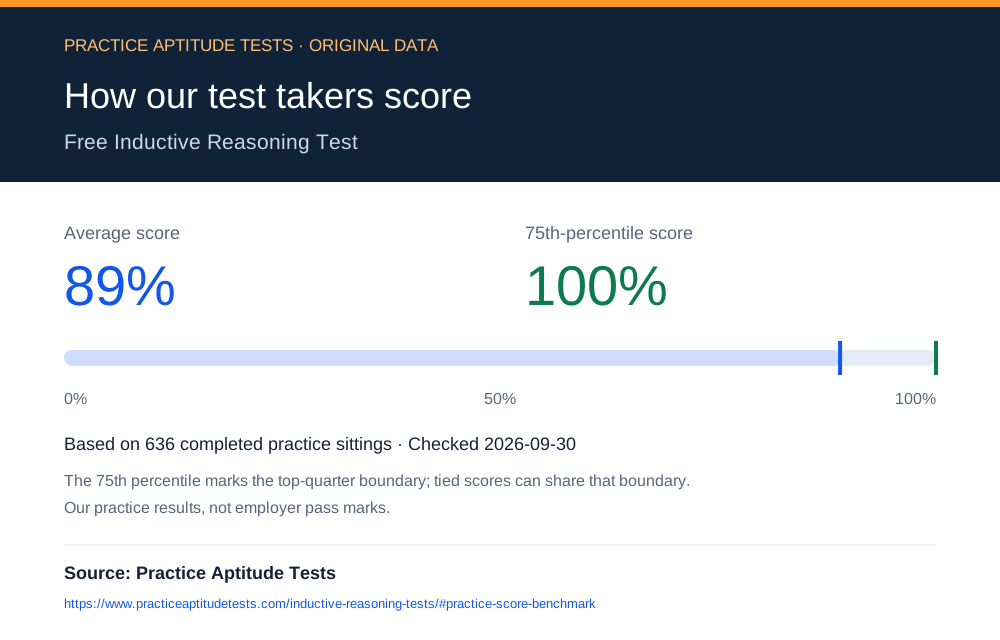
Results from our inductive reasoning test.
Source: Practice Aptitude Tests
Based on 636 completed practice sittings, all time. Checked 30 September 2026.
The 75th percentile marks the boundary of the top quarter of recorded scores; tied scores can share that boundary. These are our practice results, not employer pass marks.
We use all-time completed, scored attempts at this practice test. Repeat attempts count separately, so the sample is sittings rather than unique people.
The average is the mean score across those sittings. The 75th percentile comes from their recorded score distribution. The “checked” date is when we retrieved the figures, not the period when the tests were taken.
Sharing these figures? Please credit Practice Aptitude Tests and link to this page.
Inductive reasoning tests are among the most widely used assessments in graduate and professional recruitment, especially at large employers with structured schemes: major consulting firms, investment banks, engineering and technology companies, consumer goods businesses, and public sector programmes including the Civil Service Fast Stream.
Most employers license their tests from a small number of publishers, and the timing and question style vary between them, so find out which publisher your employer uses before you prepare seriously. It is usually named in the invitation email. Our test publisher guides cover each format, and the employer guides cover specific companies’ processes.
The methods behind the questions above, from our team
Rated 4.7 out of 5 across 74 reviews. A selection:
I liked how there was enought time for 10 questions and that the type of questions were varied. I was also impressed by how I could think of one possible correct answer.
Helps to take practice exams to help build your knowledge of what to expect and how to solve the problems. This test makes it easier to learn and score higher, due to a better understanding of what it is asking.
I enjoyed the mixture of question types. I wish there was just a tiny bit more instruction. I know that is the point of the test, but it was painfully vague at times.
Take a free test in any format, then upgrade when you know which one you need.