



Easy to understand the questions
The first 4/5 questions were not easy to work out I felt like I was missing some information. I could not really tell the hours it took to produce one item.
Graphs, tables and financial passages: margins, revenue, costs and ratios under time pressure. Every question below comes with the full working.
Free · No sign-up · Scored the moment you finish
A financial reasoning test measures how well you read financial figures and draw the right conclusion from them. Employers use it to sift applicants for finance and commercial roles before interview. You interpret data from statements, budgets and reports, then calculate figures such as margins, growth and ratios, choosing the best answer from four options. Clear reading of the numbers matters as much as the arithmetic.
Start the free test. It opens full screen, without leaving this page.
Prefer paper?
Download this test as a PDF or a second practice paper with different questions.
Worked solutions included. No sign-up.
| Score | What it suggests |
|---|---|
| 9 to 10 | Comfortably above the bar for most graduate schemes |
| 7 to 8 | Around the typical pass mark. Worth practising for speed |
| 5 to 6 | Below most employer thresholds. Focus on method before speed |
| 4 or fewer | Work through the worked solutions above before retrying |
Employers set their own thresholds and many sift on the top percentage of applicants rather than a fixed mark, so treat these as a guide.
One test tells you the style. A pack gives you the pace: batches under time pressure, marked, with the working shown.
A financial reasoning test measures how well you interpret financial data and calculate from it under time pressure. It presents information through graphs, tables and short passages, much like a numerical reasoning test, but the context is finance and the language is drawn from the financial sector.
Employers use it to sift applicants for roles where reading financial figures matters, from accountancy and banking to consulting and financial management. The skill it checks is practical: can you pull the right numbers out of a business scenario and reach a correct conclusion quickly.
Most questions are multiple choice. The arithmetic itself rarely goes beyond percentages, ratios, averages and interest, so the challenge is speed, accuracy and knowing what the financial terms mean.
Financial reasoning tests require confident basic arithmetic plus a working grasp of a few finance concepts. You do not need an accountancy qualification, but you do need to recognise the terms and know which calculation each one implies.
The maths to be fluent in:
The finance knowledge to have:
Learn the core finance terms before you sit the test, because a question can be easy arithmetic wrapped in a word you do not recognise. The vocabulary is where candidates from a non-finance background lose the most marks.
The terms worth knowing cold:
Read the question before the passage, so you know which figures you are hunting for. A financial scenario deliberately gives you more information than any single question needs, and reading it all first wastes the time the test is measuring.
A reliable order:
Watch for a fee, a tax or an exchange rate tucked into the text below a table, as it often carries the piece that makes the calculation possible.
Most employers score you against other candidates, not against a fixed pass mark: your raw score becomes a percentile. Competitive graduate schemes commonly sift at around the 70th to 80th percentile. Attempting questions matters, because most tests are built so few candidates finish, and guessing usually pays: negative marking is rare, but check the instructions.
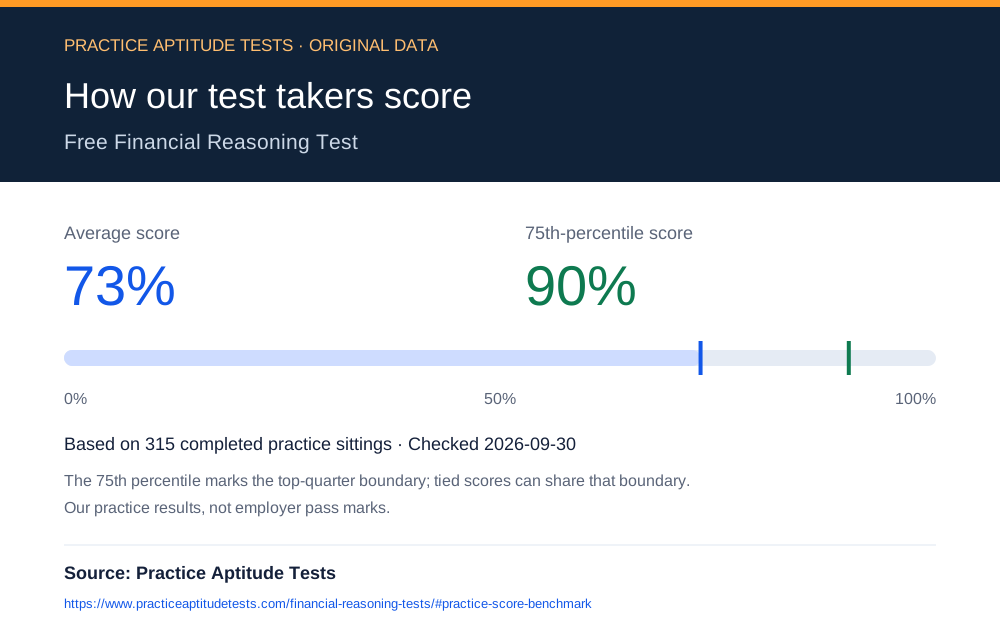
Results from our financial reasoning test.
Source: Practice Aptitude Tests
Based on 315 completed practice sittings, all time. Checked 30 September 2026.
The 75th percentile marks the boundary of the top quarter of recorded scores; tied scores can share that boundary. These are our practice results, not employer pass marks.
We use all-time completed, scored attempts at this practice test. Repeat attempts count separately, so the sample is sittings rather than unique people.
The average is the mean score across those sittings. The 75th percentile comes from their recorded score distribution. The “checked” date is when we retrieved the figures, not the period when the tests were taken.
Sharing these figures? Please credit Practice Aptitude Tests and link to this page.
Financial reasoning tests are standard across banking, accountancy, professional services and consulting, and appear for any role that involves interpreting financial data. If you are applying into finance, expect one.
Most employers license their tests from a small number of publishers, and the timing and question style vary between them, so find out which publisher your employer uses before you prepare seriously. It is usually named in the invitation email. Our test publisher guides cover each format, and the employer guides cover specific companies’ processes.
The methods behind the questions above, from our team
Rated 4.7 out of 5 across 56 reviews. A selection:
The first 4/5 questions were not easy to work out I felt like I was missing some information. I could not really tell the hours it took to produce one item.
The test was challenging enough to me to test my numerical skills and easy enough to act as confidence boost. Could I have at least two freebies that are quite challenging to test the level of difficulty?
Overall, the test was dynamic. Presented a very wide view of the possibilities of arithmetic reasoning. However, the time was a bit limited for the test in my opinion. I liked the way the questions were set. The first batch gave me a challenge.
Take a free test in any format, then upgrade when you know which one you need.