Syllogisms, conditional statements and cannot-be-concluded questions, in the formats employers actually set. Every question below comes with the logic explained, not just the answer.
A deductive reasoning test measures how well you apply general rules to reach a conclusion that must be true. Employers use it to sift applicants for roles that rely on sound reasoning before interview. You are given statements or conditions and asked which conclusion logically follows, choosing the best answer from the options provided. It rewards precise reasoning rather than guessing or general knowledge.
A deductive reasoning test measures whether you can draw the conclusion
that must be true from a set of stated facts, and how quickly you can do
it. It is a test of valid reasoning, not of knowledge. You are given the
premises, and exactly one of the answer options follows from them with
certainty.
The questions are deliberately abstract. They do not rely on any
job-specific expertise or culturally specific knowledge, which is what lets
an employer use the same test across very different candidates. Everything
required to answer is in front of you, so bringing in an outside assumption
is usually how a wrong answer is chosen.
Employers use it because the skill transfers directly to work. Someone who
can take a policy, a rule or a contract clause and say precisely what does
and does not follow from it is doing the same thing a lawyer, an analyst or
an engineer does every day. It is judgement about what the evidence
actually supports.
How are deductive reasoning tests scored?
Most employers score you against other candidates, not against a fixed
pass mark: your raw score becomes a percentile. Competitive graduate
schemes commonly sift at around the 70th to 80th percentile. Attempting
questions matters, because most tests are built so few candidates finish,
and guessing usually pays: negative marking is rare, but check the
instructions.
You will usually have in the region of a minute per question, and the tests are built so that few candidates comfortably finish. ** A minute lost early is a question you never reach at the end, and both cost the same mark.
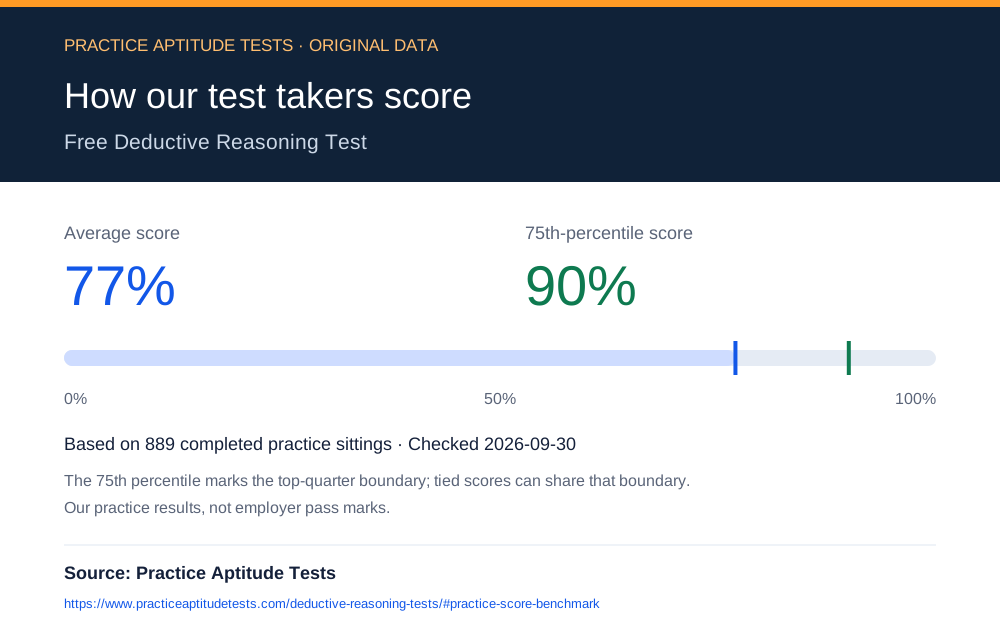
Based on 889 completed practice sittings, all time. Checked 30 September 2026.
The 75th percentile marks the boundary of the top quarter of recorded scores; tied scores can share that boundary. These are our practice results, not employer pass marks.
How we calculate these figures
We use all-time completed, scored attempts at this practice test. Repeat attempts count separately, so the sample is sittings rather than unique people.
The average is the mean score across those sittings. The 75th percentile comes from their recorded score distribution. The “checked” date is when we retrieved the figures, not the period when the tests were taken.
Sharing these figures? Please credit Practice Aptitude Tests and link to this page.
Who uses deductive reasoning tests?
Deductive reasoning tests are standard in graduate and professional hiring
across law, finance, consulting, technology and the civil service. If a role
turns on interpreting rules and evidence, expect one.
Most employers license their tests from a small number of publishers,
and the timing and question style vary between them, so find out which
publisher your employer uses before you prepare seriously. It is usually
named in the invitation email. Our test publisher guides
cover each format, and the employer guides
cover specific companies’ processes.
Reviews
Rated 4.7 out of 5 across 86 reviews. A selection:
It is challenging
I liked that you as an individual have to take note of fine details, especially when it comes to patterns and shapes. I disliked that it takes time to read and understand the longer questions, which lessens your time to actually answer the question.
Ammaarah Arendse · South Africa · November 2021
My opinion
I loved this test because it will help you with your maths and it will give you solutions if needed. Also, it will give you your percentage score and how much the average pass mark should be. Such an amazing site.
Luwaita Luwinas · UK · July 2021
Very good versatility of questions & logic.
the last one seemed impossible to me, but it was fun!!Of course, there is a solution and I do not question that. Not everyone should be able to solve all of them :D
Peter Klaus · Germany · April 2021
Start practising today
Take a free test in any format, then upgrade when you know which one you need.