


Good introduction to mechanical reasoning
Clearly worded questions with simple but effective diagrams. Provides an indication of the principles and attributes required by such tests
Pulleys, levers, gears, hydraulics and forces, in the format Pearson sets: 55 questions in 25 minutes. Three worked examples below, with the reasoning explained.
Reading about the format only takes you so far. A pack gives you the pace: batches under time pressure, marked, with the working shown.
The Bennett Mechanical Comprehension Test (BMCT) measures how well you understand mechanical concepts and apply them to solve problems. It is a multiple-choice test built from images and diagrams, drawing on four areas: mechanical comprehension, spatial visualisation, knowledge of basic mechanical and physical laws, and deducing how things work.
It was first published in 1940 by the Psychological Corporation, now Pearson Education, which makes it one of the longest-running tests still in use. As a recruitment tool it is a proven predictor of performance in industries that depend on technical aptitude. Some employers also use it after hiring, either to identify what a new starter needs training in or as a risk-management check, since a low scorer may not suit a role where mistakes are dangerous.
The BMCT is used in application and retention processes at a number of multinational companies, concentrated in work that is physical and technical:
It also appears alongside other types of aptitude test when an employer is assessing for managerial or multi-functional roles.
A typical BMCT is 55 questions in 25 minutes, which is about 30 seconds each. The questions themselves are straightforward, so the clock is the real constraint. Two untimed practice questions come first, so you can settle into the layout and the wording before the timer starts. Every question is a graphic followed by a multiple-choice question.
The topics, roughly in order of how many questions they carry:
The weighting is uneven and worth knowing: around 68% of the questions on a typical BMCT-II concern force and movement, velocity and fluid mechanics, and pulleys and levers carry more questions than any other single topic.
Pearson sends the employer a score report carrying your raw score and a percentile ranking against a normative group, so there is no fixed pass mark: the threshold moves with the role. An airline engineering post will be pitched higher than a manufacturing operative post. Broadly, the bands read as follows.
The three questions below use the BMCT’s most heavily weighted topics. Work them before reading the solutions.
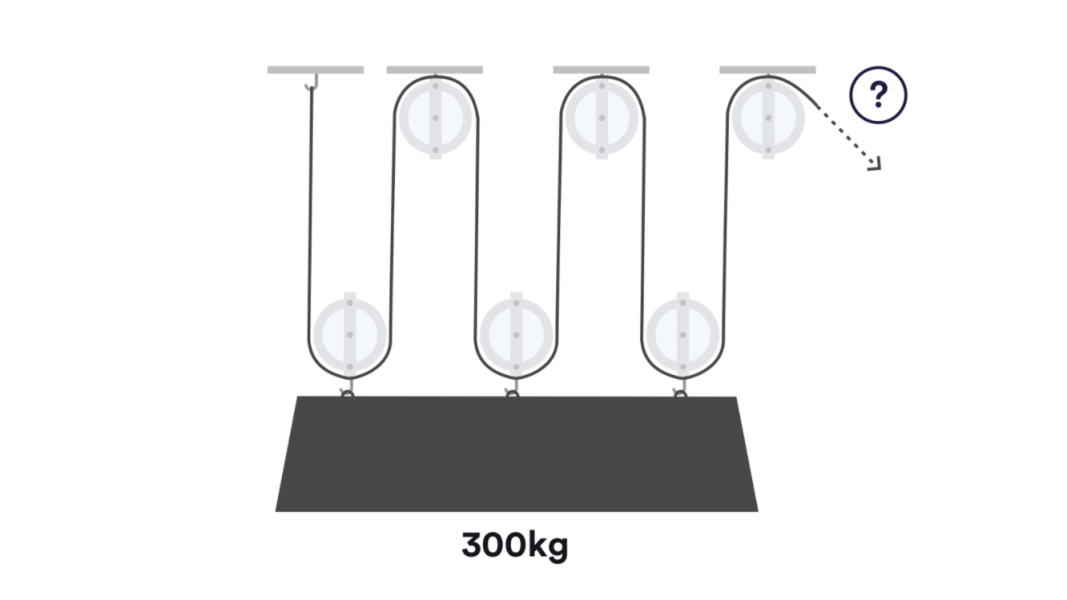
Question 1. What force is required to lift this weight?
A) 30kg B) 50kg C) 100kg D) 150kg
Question 2. If two cogs are turning together, one with 30 teeth and the other with 20, how many revolutions would the smaller cog have turned once the larger cog has rotated 15 times?
A) 21 B) 21.5 C) 22 D) 22.5
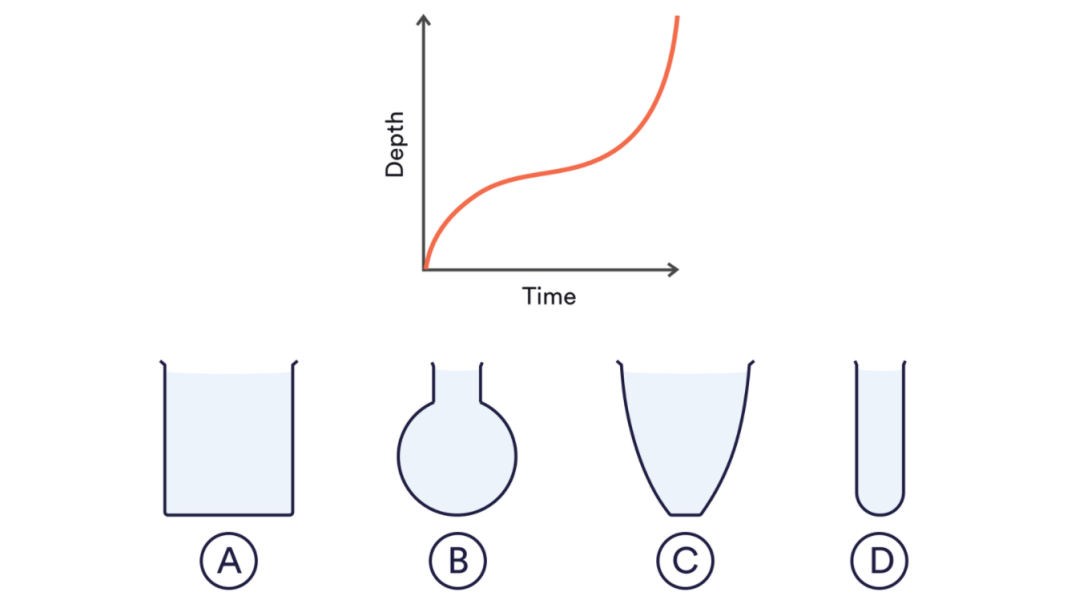
Question 3. Which container is represented by this graph as it fills with water?
Solutions.
Question 1 is B, 50kg. Six sections of rope support the weight, so divide the total by six: 300 / 6 = 50kg.
Question 2 is D, 22.5. The larger cog has 1.5 times as many teeth, so the smaller one turns 1.5 times faster: 15 x 1.5 = 22.5.
Question 3 is B. The steepest parts of the graph are where the container is narrowest, because a narrow section fills fastest. The graph describes a container that starts narrow, widens, then narrows again at the top.
The methods behind the questions above, from our team
Rated 4.8 out of 5 across 229 reviews. A selection:
Clearly worded questions with simple but effective diagrams. Provides an indication of the principles and attributes required by such tests
The test is easy to introduce you into pulleys and calculating the amount of force needed to lift/pull the weight!
I got stumped on some fundamental questions I assumed I remembered. Great refresher for concepts in physics, mechanics, optics, and chemistry.
Take a free test in any format, then upgrade when you know which one you need.